Best smart thermostats for Your Home Upgrade, Walking into a perfectly climate-controlled home without touching a single button might sound futuristic, but it’s exactly what smart thermostats deliver every single day. These clever devices have transformed how we heat and cool our spaces, making comfort effortless while trimming energy bills at the same time. If you’re considering upgrading your home, a smart thermostat represents one of the most practical investments you can make.
Unlike the old-school thermostats that required constant manual adjustments, modern smart thermostats learn your habits, respond to your location, and even take weather conditions into account. The result is a home that feels just right when you’re there and saves energy when you’re not.motili
What Makes a Thermostat “Smart”
A smart thermostat goes far beyond simple temperature control. These devices connect to your home’s WiFi network, allowing you to manage heating and cooling from your smartphone, tablet, or computer. You can adjust settings from the office, monitor energy usage in real time, and receive alerts about your HVAC system’s performance.consumerreports
The learning capabilities set these thermostats apart from their programmable predecessors. Many models use machine learning algorithms to understand your daily patterns and automatically create schedules that match your lifestyle. They notice when you typically wake up, leave for work, return home, and go to sleep—then adjust temperatures accordingly without requiring any programming on your part.airflowdesigns
Voice control integration adds another layer of convenience. Most best smart thermostats work seamlessly with Amazon Alexa, Google Assistant, Apple Siri, and Samsung SmartThings. You can simply ask your preferred voice assistant to change the temperature without getting up from the couch.aeheatingandcooling
Essential Features to Look For
Remote Sensors and Multi-Room Control
Homes rarely heat and cool evenly. The upstairs bedroom might be sweltering while the basement stays chilly, creating comfort problems throughout the day. Smart thermostats with remote sensors solve this issue by monitoring temperature in multiple rooms.
The sensors detect both temperature and occupancy, ensuring the rooms you actually use stay comfortable. If you’re working from home in your office, the system prioritizes that space rather than heating or cooling empty bedrooms. This targeted approach improves comfort while reducing wasted energy.
Geofencing Technology
Geofencing creates a virtual boundary around your home using your smartphone’s location. When you leave this radius, the thermostat automatically adjusts to an energy-saving mode. As you return and cross back into the boundary, it ramps up to ensure your home reaches a comfortable temperature by the time you walk through the door.
This feature eliminates the common problem of forgetting to adjust the thermostat before leaving for vacation or heading to work. The system handles it automatically based on your actual location rather than a preset schedule.
App Control and Monitoring
The smartphone apps that accompany smart thermostats have become remarkably intuitive and powerful. Beyond basic temperature adjustments, these apps provide detailed energy usage reports, maintenance reminders, and system alerts.
You can review how much energy you used last month compared to the previous month, identify patterns in your heating and cooling costs, and make informed decisions about your settings. Some apps even offer tips for optimizing efficiency based on your specific usage patterns.
Real Energy Savings You Can Measure
The energy savings from smart thermostats aren’t just marketing hype—they’re backed by solid data. According to the Environmental Protection Agency, smart thermostats that meet Energy Star criteria save users an average of 8 percent on their utility bills. That translates to roughly $50 per year for the typical household, though savings can be considerably higher in regions with extreme temperatures or elevated energy costs.
Independent studies of actual users show even more impressive results. Data from customers reveals average savings between 10-12 percent on heating and 15 percent on cooling. Some manufacturers report users saving up to 26 percent on HVAC costs compared to traditional thermostats.
The secret behind these savings is simple yet effective: smart thermostats turn off your heating and air conditioning more frequently than regular thermostats without compromising your comfort. While traditional programmable thermostats theoretically could achieve similar results, research shows that 40 to 70 percent of owners never actually use the scheduling features because the interfaces are too complicated. The app-based controls on smart models make scheduling so easy that people actually use it, which directly translates to real-world energy savings.
Understanding Compatibility with Your HVAC System
Before purchasing any smart thermostat, you absolutely must verify compatibility with your existing HVAC system. Not every thermostat works with every heating and cooling setup, especially if you have an older or more complex system.
System Types and Voltage
HVAC systems come in several configurations:
- Single-stage systems offer one level of heating and cooling
- Multi-stage systems provide variable heating and cooling levels for better efficiency
- Heat pump systems can both heat and cool your space
- Duct-free mini-split systems provide targeted climate control without ductwork
Most smart thermostats are designed for low-voltage systems, which are common in residential homes. If you have a high-voltage or line-voltage system, you’ll need to find a model specifically designed for that type. For homes with complex multi-stage systems, make sure your chosen thermostat supports multiple stages to maximize your system’s efficiency.
The C-Wire Requirement
One technical detail that trips up many homeowners is the C-wire, or common wire. Smart thermostats need continuous power to maintain their WiFi connection, run their displays, and process data. The C-wire provides this constant power supply.
Many older homes lack a C-wire because traditional thermostats didn’t require one. If your current thermostat doesn’t have a C-wire, you have a few options: use a power adapter kit (often included with the thermostat), install a new C-wire, or choose one of the few models that work without one. Some manufacturers offer simple connector solutions as affordable alternatives to running new wiring.
Using Compatibility Checkers
Most major manufacturers provide online compatibility tools on their websites. These tools guide you through identifying your system type, checking your current wiring, and confirming whether a specific model will work with your setup. Taking five minutes to use these checkers before purchasing can save you significant frustration later.
If you’re uncertain about your system or uncomfortable working with electrical components, consulting an HVAC professional is always the safest route. They can assess your system, confirm compatibility, and handle installation if needed.
Installation: DIY or Professional?
Installing a smart thermostat is surprisingly straightforward for many homeowners. The process typically follows these steps:
- Turn off power to your HVAC system at the breaker
- Remove your old thermostat’s faceplate and photograph the wiring
- Label each wire according to its terminal connection
- Disconnect the wires and remove the old baseplate
- Install the new baseplate, ensuring it’s level
- Connect the wires to the corresponding terminals
- Attach the new thermostat to the baseplate
- Restore power and connect to WiFi
The entire process usually takes 30 minutes to an hour. Most manufacturers provide detailed instructions, video tutorials, and even compatibility help directly on their websites.
That said, professional installation might be the better choice if you’re dealing with a complex HVAC system, need to install a C-wire, or simply aren’t comfortable working with electrical wiring. The peace of mind can be worth the installation fee, and a professional can confirm everything is configured correctly from the start.
Choosing the Right Model for Your Needs
The market offers dozens of smart thermostat options, but the best smart thermostats share certain qualities. Models from established brands like Ecobee, Google Nest, and Honeywell Home consistently receive high marks for performance, reliability, and feature sets.
When evaluating options, consider what matters most for your situation:
For homes with uneven heating or cooling, prioritize models that support remote sensors and can monitor multiple zones. These systems ensure every room stays comfortable rather than just the space where the main thermostat is mounted.
For maximum energy efficiency, look for models with strong learning algorithms and geofencing capabilities. These features automate energy savings without requiring you to constantly adjust settings manually.
For integration with existing smart home devices, verify that your chosen thermostat supports the platforms you already use. If you’ve invested in Amazon, Google, or Apple ecosystems, make sure your thermostat will play nicely with those systems.
For simplicity and ease of use, examine the app interface and physical controls. Some models feature touchscreens while others rely more heavily on smartphone apps. Choose the interface style that fits your preferences and technical comfort level.
Making Smart Thermostats Even Smarter
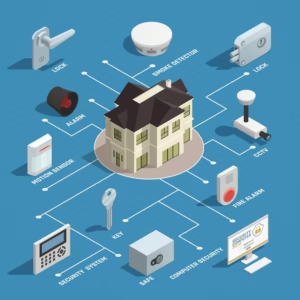
The real power of smart thermostats emerges when they connect with other devices in your home. Integration with smart lighting, door locks, security systems, and voice assistants creates an ecosystem where everything works together seamlessly.
For example, your thermostat might communicate with smart window shades to block afternoon sun and reduce cooling needs. It could coordinate with your smart ventilation system to improve air quality when outdoor conditions are favorable. Some thermostats even integrate with home security platforms, adjusting temperatures when your system arms in away mode.
When building or expanding a smart home setup, look for thermostats that support open standards like Matter, Apple HomeKit, and Google Home. These platforms provide flexibility if you decide to change other components later, preventing you from getting locked into a single brand’s ecosystem.
Frequently Asked Questions
Do smart thermostats really save money?
Yes, studies consistently show that smart thermostats reduce heating and cooling costs. The Environmental Protection Agency reports average savings of 8 percent on utility bills, while some manufacturers cite savings between 10-26 percent depending on usage patterns and climate. The key is that these devices make energy-saving behaviors automatic and easy, which leads to actual savings rather than theoretical ones.
Will a smart thermostat work with my old HVAC system?
Most smart thermostats work with a wide range of HVAC systems, but compatibility isn’t universal. Older systems may lack certain wiring, particularly the C-wire that provides continuous power. Check the manufacturer’s compatibility tool before purchasing, and consider consulting an HVAC professional if you’re uncertain about your system type or wiring configuration.
Can I install a smart thermostat myself?
Many homeowners successfully install smart thermostats themselves using the manufacturer’s instructions. The process typically takes 30-60 minutes and requires basic tools. However, professional installation is recommended if you need to run new wiring, have a complex multi-zone system, or aren’t comfortable working with electrical components.
What’s the difference between a programmable thermostat and a smart thermostat?
Programmable thermostats allow you to set temperature schedules but lack WiFi connectivity and learning capabilities. Smart thermostats offer app control, learn your habits over time, use geofencing to detect when you’re home or away, and provide detailed energy reports. Research shows that while programmable thermostats can theoretically save energy, smart thermostats achieve better real-world results because their interfaces are easier to use.
Do I need sensors with my smart thermostat?
Remote sensors aren’t essential but can significantly improve comfort in homes with uneven heating or cooling. If you have a simple, single-level home with consistent temperatures throughout, you probably don’t need sensors. However, multi-story homes, split-level layouts, or houses with temperature variations between rooms benefit greatly from sensor-equipped systems.
Which voice assistants work with smart thermostats?
The best smart thermostats support multiple voice platforms including Amazon Alexa, Google Assistant, Apple Siri via HomeKit, and Samsung SmartThings. Check the specific model’s compatibility list to confirm it works with your preferred voice assistant before purchasing.