
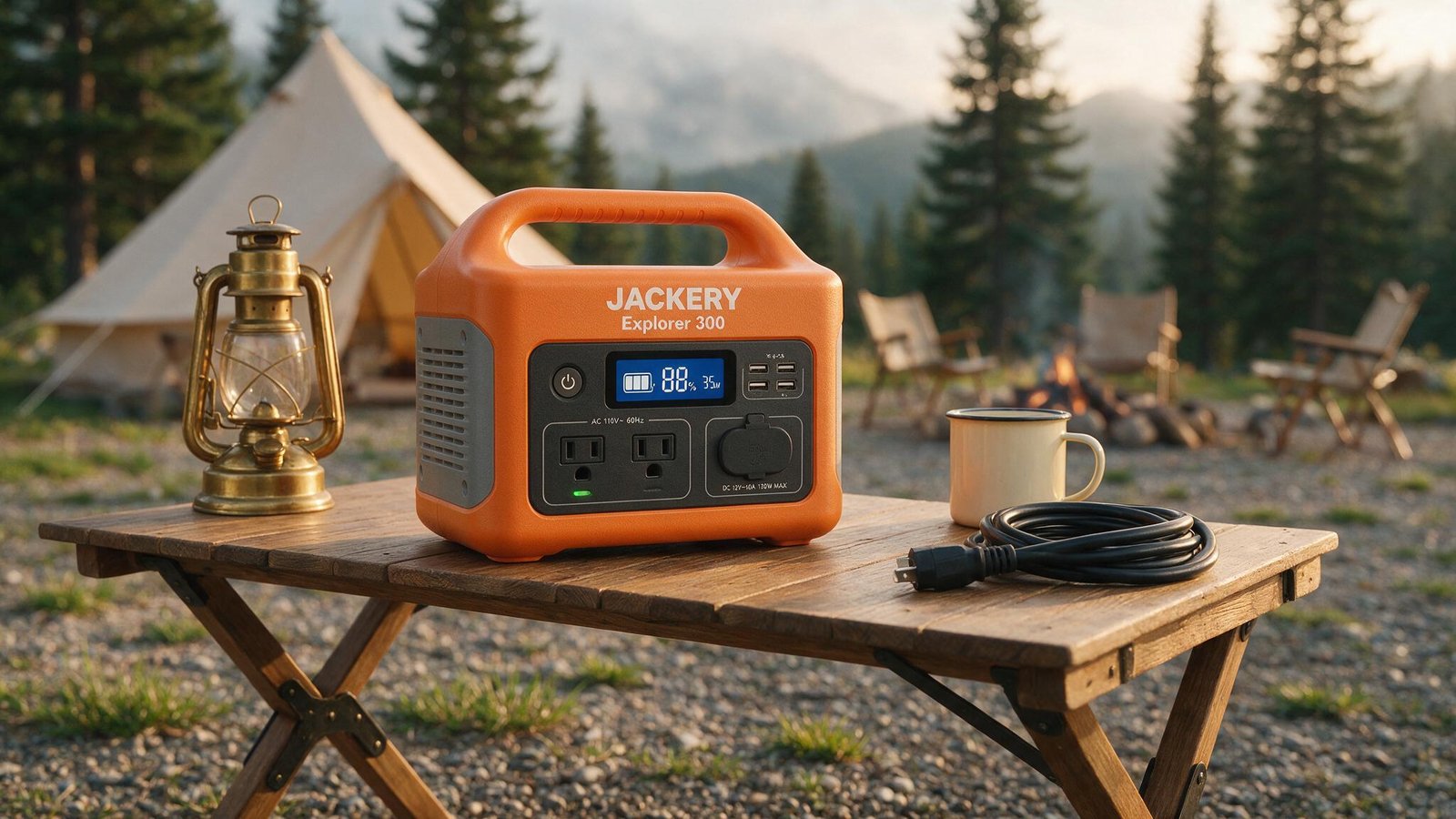
Let me be honest with you. The first time my power went out in the middle of the night, with my phone dying and the room completely dark, I promised myself I’d never be that unprepared again. That’s where a compact Portable Power Station stepped in—and the Jackery Explorer 300 quickly became one of those “I feel safer just having it here” gadgets.
In this guide, I’m talking to you like a friend who’s tested gear and hates overcomplicating things. We’ll look at what this Portable Power Station really does, why it matters, how it compares to a few alternatives, and where smaller battery packs still fit in the picture.
Meet the Jackery Explorer 300 Portable Power Station
The Jackery Explorer 300 is a compact Portable Power Station made for camping, short trips, and backup power during blackouts. It’s rated at about 293Wh (often rounded to 292Wh), which means it can recharge small devices several times or run low‑power gear for hours.
Unlike tiny pocket chargers, this Portable Power Station is more like a tiny generator without fuel or noise. It has:
- AC outlets for regular plugs.
- A 12V car‑style DC outlet.
- Multiple USB ports, including USB‑C fast charging.
So yes, you’re getting more than just a phone charger—you’re getting a Portable Power Station that can sit next to you in a tent, RV, or living room when the lights go out.
Key Specs and Real‑World Use Cases
Core specs (simple version)
Here’s what the Explorer 300 brings to the table:
| Feature | Details |
|---|---|
| Battery capacity | ~293Wh lithium battery |
| Inverter output | 300W pure sine AC, with surge up to 600W |
| Weight | Around 7–8 lbs, very portable |
| Outputs | 2 AC outlets, 12V DC, USB‑C, USB‑A |
| Charging options | Wall adapter, car DC, USB‑C, solar panel |
In practice, this Portable Power Station can:
- Recharge a typical laptop a few times.
- Charge a phone dozens of times.
- Run small devices like lights, fans, routers, or a CPAP machine for several hours.
That’s a big mental jump from pocket chargers that mainly handle phones and tablets. This Portable Power Station sits in that sweet spot—more powerful than most battery packs, but still compact enough to carry easily.
Outdoor gear reviewers often describe it as “right‑sized”: big enough to matter, small enough to actually bring with you instead of leaving it in the garage.
Portable Power Station vs Small Battery Packs
You might be wondering: “If the focus keyword is Portable Power Station, why talk about smaller chargers at all?” Because in real life, people move between small packs and bigger solutions depending on how much they need to run.
How the Explorer 300 compares to typical battery packs
| Type | Example | Capacity / Use Case |
|---|---|---|
| Small battery pack | 10,000mAh pocket charger | Phone + earbuds on commute |
| Large USB‑C pack | 20,000mAh high‑speed unit | Phone + tablet + some laptop charging |
| Jackery Explorer 300 | 293Wh Portable Power Station | Small appliances, laptops, multiple devices |
Regular phone chargers are perfect for everyday carry, but they don’t offer AC outlets or the same runtime for devices like routers or medical gear. A Portable Power Station like the Explorer 300 steps into that gap, acting like a “super‑charger” for bigger needs while still staying relatively portable.
For someone coming from pocket‑sized solutions, this is that next level where you stop worrying about just your phone and start thinking about your whole setup.
Solar Generator Potential: Explorer 300 as a Portable Power Station
One of the coolest things about this unit is how easily it turns into a solar generator. Pairing this Portable Power Station with a 100W solar panel lets you recharge the station using sunlight, which is a game changer for camping or long blackouts.
Solar charging basics
- MPPT solar charging support for better efficiency.
- A 100W panel can recharge the Explorer 300 in several hours of good sun.
- Works as a clean backup power source for outages or off‑grid trips.
This is where tiny battery packs start to feel small. Yes, you can have solar‑compatible phone chargers, but a dedicated Portable Power Station with proper solar inputs is built to handle full‑day power needs more reliably.
Photographers, campers, and van‑lifers often pair the Explorer 300 with a folding solar panel and basically forget what “low battery anxiety” feels like.
Comparison: Explorer 300 vs Other Portable Power Stations
To make this useful for your readers, let’s compare the Explorer 300 to a few other Portable Power Station options, not just phone chargers.
Compact Portable Power Station comparison
| Model | Battery (Wh) | AC Output (W) | Weight / Size Feel | Notable Strengths |
|---|---|---|---|---|
| Jackery Explorer 300 | ~293 | 300 | Light, compact | Easy to carry, simple interface |
| Eco‑focused compact unit | ~250–300 | 300–600 | Slightly larger | Higher AC wattage, more outlets |
| GOLABS‑type 300 | ~299 | 300 | Similar size | Different chemistry, often more cycles |
| LiFePO4‑based station | 250–400 | 300–600 | Varies | Longer cycle life, thousands of cycles |
From tests and reviews, a few themes show up:
- The Explorer 300 is praised for its size‑to‑capacity balance and ease of use.
- Some rivals offer higher AC wattage but at the cost of more bulk.
- LiFePO4‑based Portable Power Station models focus on long life and durability, which is ideal if you plan to use them heavily for years.
For readers who only know simple phone chargers, this table shows how a Portable Power Station can be the next step when life demands more than just USB power.
When a Portable Power Station Beats a Phone Charger
Let’s keep it real. When does a Portable Power Station like the Explorer 300 beat standard phone‑only solutions?
You choose a Portable Power Station when:
- You need AC outlets and want to run small appliances or special devices (CPAP machines, cameras, routers, lights).
- You camp, travel, or work outdoors and need reliable off‑grid power.
- You want one central unit instead of juggling multiple tiny chargers.
You stick with small battery packs when:
- You mainly charge phones, earbuds, and maybe a tablet.
- You care more about pocket size than running bigger gear.
- You just need a backup for everyday commuting and city life.
The Explorer 300 sits right in the middle. It gives you more freedom than simple battery packs, but it’s not so big that it feels like a piece of furniture. It’s a Portable Power Station you actually bring along, not just brag about owning.
Pros and Cons of the Jackery Explorer 300 Portable Power Station
What I like
- Portable size: Easy to carry with a solid handle; doesn’t feel like a burden on trips or in a small apartment.
- Flexible charging: Wall outlet, car DC, USB‑C, and solar options give you multiple ways to keep this Portable Power Station topped up.
- User‑friendly interface: Simple LCD and buttons; you don’t need an engineering degree to use it.
- Reliable brand reputation: Jackery has built a strong name in the portable power world, especially for Portable Power Station products.
What’s not perfect
- Capacity isn’t enough for big appliances like full‑size fridges; this Portable Power Station is made for small to medium devices.
- The display and AC reading can lag a bit and aren’t always ultra‑precise.
- It doesn’t include extras like a big built‑in light, which some users wish it had.
Even with these downsides, many users still call it a “damn good Portable Power Station” because it fits the everyday use scenario so well: camping, emergency backup, and short trips.
FAQs About Jackery Explorer 300 and Portable Power Stations
Is the Jackery Explorer 300 better than normal phone chargers?
It depends on what you need. For phones and small gadgets only, a simple charger is smaller and cheaper. For camping, blackouts, and running multiple devices—including AC devices—the Explorer 300 Portable Power Station is a big upgrade over standard battery packs.
Can the Explorer 300 run a laptop?
Yes. This Portable Power Station can charge laptops using its AC outlets or USB‑C port, and many users rely on it for that exact purpose during travel or outages.
Is it a good backup for power outages?
It’s a strong backup for short outages, especially for phones, lights, routers, and low‑draw devices. It’s not designed to run large home appliances, but as a compact Portable Power Station, it works very well in a small home or apartment.
How does solar charging work on the Explorer 300?
You can connect compatible solar panels (like a 100W panel) to charge this Portable Power Station using sunlight. With proper solar input, it becomes a quiet solar generator that you can use day after day during off‑grid trips or extended power cuts.
Is it worth buying if I already own several battery packs?
If you only charge phones and earbuds, you may be fine with what you have. But if you camp, travel, work remotely, or want blackout protection with AC outlets and more capacity, a Portable Power Station like the Explorer 300 adds something that simple chargers can’t easily match.