Affiliate Disclosure: This post contains affiliate links. If you buy through links on this page, we may earn a small commission at no extra cost to you. This helps keep the site running and our guides free.
By Vimalanathan · Last checked: October 23, 2026
Would you know if your kitchen caught fire while you were two hours from home? Most of us wouldn’t. That gap is exactly what smart smoke and carbon monoxide detectors are built to close. They sound the siren at home, and they also send an alert to your phone.
Google stopped making the Nest Protect, so plenty of homeowners are shopping again. I dug through reviews, manufacturer pages, and safety guidance to build this list. I haven’t tested these units myself, so treat this as a carefully researched shortlist, not a lab report.
How We Picked: We compared smart smoke and carbon monoxide detectors on sensor type, power source (battery vs hardwired), smart home compatibility, app alerts, interconnection, and whether core alerts need a subscription. Picks are based on manufacturer specifications and published safety guidance, not hands-on testing.
Why Smart Smoke & Carbon Monoxide Detectors Are Worth It
A regular alarm only helps if someone is home to hear it. A smart one also tells your phone, and many add spoken warnings. Some even send low-battery notices to an app, so you skip the 3 a.m. chirping.
Carbon monoxide (CO) is the sneaky part. You can’t see it or smell it. The CDC’s carbon monoxide basics page is a good place to learn the risks, and the agency reports that more than 400 Americans die each year from unintentional CO poisoning. A combo unit watches for both threats with one device. For most houses, that makes smart smoke and carbon monoxide detectors an easy upgrade.
Quick Comparison: Best Smart Smoke Detector Options
Here’s how the seven smart smoke and carbon monoxide detectors line up at a glance.
| Product | Best For | Standout Feature |
|---|---|---|
| First Alert SC5 | Replacing a Nest Protect | Battery or hardwired, and you can mix them |
| Kidde Smart Smoke & CO with Ring (Battery) | Ring users | Free app alerts with no wiring |
| Kidde Smart Smoke & CO with Ring (Hardwired) | Homes with existing wiring | Hardwired with AA backup |
| X-Sense Smart Smoke/CO Combo | Covering a whole house affordably | Interconnected multi-pack |
| SimpliSafe Smoke & CO Detector | SimpliSafe owners | Works with its security system |
| Kidde Smart Smoke & CO with Air Quality Monitor | Extra air data | Alexa and Google Home support |
| Place Smart Smoke/CO Detector | Room-specific monitoring | Models tailored to each room |
The 7 Best Smart Smoke & Carbon Monoxide Detectors
1. First Alert SC5
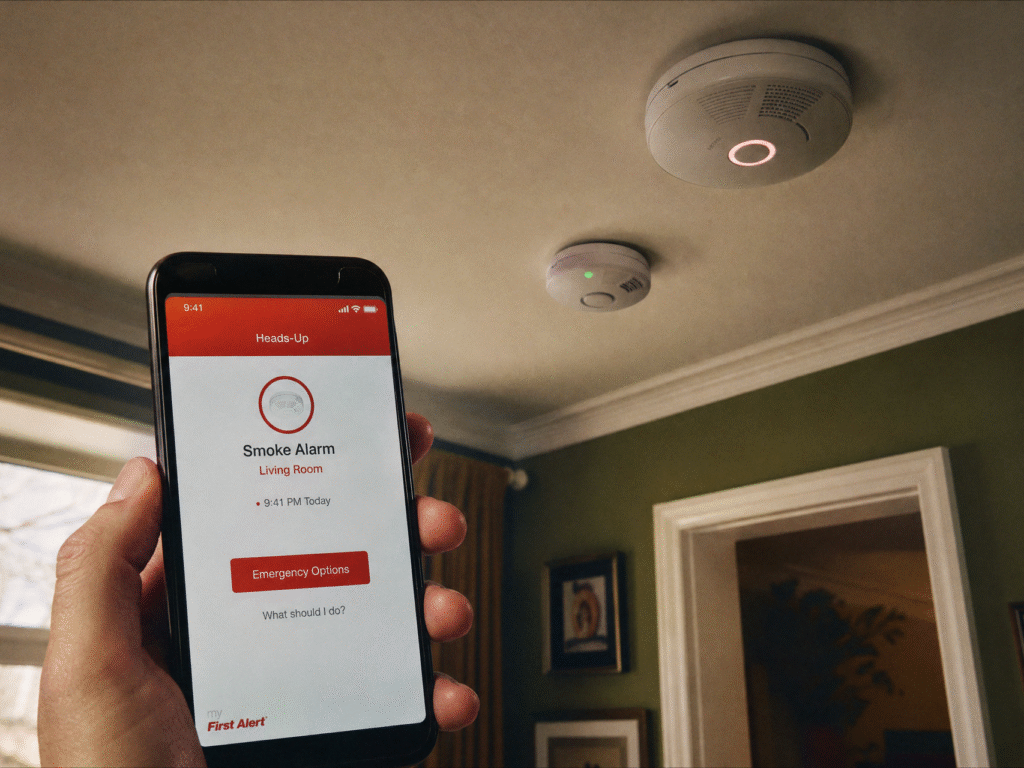
The First Alert SC5 is the official stand-in for the Nest Protect. It connects over Wi-Fi and speaks its warnings out loud. Google itself points former Nest owners toward it.
Key features: Photoelectric and electrochemical sensors, battery or hardwired versions, Google Home support, and the same mounting bracket the Nest Protect used.
Pros: You can mix battery and hardwired units in one home. It’s a natural fit for Google Home households.
Cons: It has fewer features than the Nest Protect. The voice is quiet, you can’t adjust its volume, and the night-time pathlight is gone. It’s also pricey.
2. Kidde Smart Smoke & CO with Ring (Battery)
This Kidde model runs on AA batteries and reports into the Ring app. Smoke, CO, and low-battery alerts show up in the app for free. A Ring subscription is optional and adds 24/7 professional monitoring.
Key features: Voice alerts, wire-free interconnect with compatible Kidde alarms, and batteries that need changing about once a year.
Pros: No wiring needed, and basic alerts don’t require a subscription.
Cons: The wire-free interconnect only works with other compatible Kidde alarms. You’ll also swap AA batteries each year.
3. Kidde Smart Smoke & CO with Ring (Hardwired)
Got wiring in the ceiling already? This hardwired Kidde is the swap-in version. It draws power from your house and keeps AA batteries as a backup.
Key features: Ring app alerts, voice alerts, interconnected alarms, and battery backup.
Pros: Steady house power with a safety net if the power drops.
Cons: Installation means working with household wiring. If you’re not comfortable with that, hire an electrician.
4. X-Sense Smart Smoke/CO Combo
The X-Sense kit is the budget-friendly way to cover a whole house. It comes as a multi-pack of battery-powered, interconnected alarms. When one goes off, they all go off.
Key features: A hub that links the alarms to the cloud, an app that shows each alarm’s battery level, adjustable volume and tone, and up to 12 people connected. Optional professional monitoring is available through Noonlight.
Pros: Affordable coverage and easy placement anywhere.
Cons: No hardwired option, which can matter in newer homes. It also doesn’t connect to Alexa or Google Home. One reviewer’s unit tripped from shower steam, so keep it away from bathrooms.
5. SimpliSafe Smoke & CO Detector
This is a SimpliSafe product for SimpliSafe homes. It’s an interconnected smart detector that plugs into the company’s security system. One app then handles both break-ins and fires.
Key features: Smoke and CO sensing, system integration, and optional professional monitoring.
Pros: Neat if you already own the security gear.
Cons: It costs more than most standard interconnected Wi-Fi detectors. Emergency dispatch also requires a professional monitoring plan. TechHive called it nice to have, not essential.
6. Kidde Smart Smoke & CO with Air Quality Monitor
Want more than smoke and CO? This Kidde model also keeps an eye on indoor air quality. It sends Wi-Fi alerts to your phone and works with Alexa and Google Home.
Key features: Smoke detection, CO detection, air quality monitoring, and voice assistant support.
Pros: Extra air data and two assistant options.
Cons: It requires a hardwired connection.
7. Place Smart Smoke/CO Detector
Place takes a different approach. It sells detectors built for specific rooms. The kitchen version, for example, tracks smoke, CO, natural gas, VOCs, temperature, and humidity. A base model covers just smoke and CO.
Key features: Room-specific models, a well-designed app, and a battery backup.
Pros: Rich data, and a sleeker look than most alarms.
Cons: It has a high price tag, is hardwired only, and doesn’t work with any smart home system.
How to Choose the Best Smart Smoke Detector
Before you buy smart smoke and carbon monoxide detectors, ask three questions.
Battery or hardwired?
Hardwired alarms pull power from your house and link to each other. Battery units go anywhere, but you have to look after the batteries. Some newer homes need at least one hardwired alarm under local rules, so check yours first.
Does it match your smart home?
Pick the brand that fits your setup:
- Google Home: First Alert SC5
- Ring: both Kidde Ring models
- Alexa and Google Home: the Kidde air quality model
- No smart home link: X-Sense and Place
What about subscriptions and brand lock-in?
Basic alerts are often free. Professional monitoring usually costs extra. Interconnection can also lock you into one brand, so buy alarms from the same family when you can.
Where to Install Your Smart Smoke Detector
Smart smoke and carbon monoxide detectors only protect you where you put them. Smart or not, placement rules stay the same.
Smoke alarm placement
NFPA’s public education resources recommend alarms inside every bedroom, outside each sleeping area, and on every level, including the basement. Keep them at least 10 feet from cooking appliances to cut down on false alarms.
CO alarm placement
The CPSC’s carbon monoxide alarm guidance calls for CO alarms on every level of the home and outside each separate sleeping area.
Test and replace
Test your alarms monthly by pressing the test button. Replace each one 10 years after its manufacture date, which is printed on the back. If you still own a Nest Protect, Google says it keeps working through its expiration date.
Final Thoughts on Smart Smoke & Carbon Monoxide Detectors
There’s no single winner for every house when it comes to smart smoke and carbon monoxide detectors. Google Home fans should start with the First Alert SC5. Ring users will like the Kidde models. Anyone covering a lot of rooms on a budget should look at X-Sense. If you want the best smart smoke detector for your own setup, match it to your wiring and your app first. Whichever you choose, smart smoke and carbon monoxide detectors only work when they’re installed, tested, and replaced on time.
For more ways to protect your home, see our Home Safety hub and our guide to the best home gadgets for homeowners.
FAQ
1. What do smart smoke and carbon monoxide detectors do that regular ones don’t?
They send alerts to your phone, many speak warnings aloud, and they report battery status in an app.
2. Do smart smoke and carbon monoxide detectors need a subscription?
Not for basic alerts on the Kidde Ring models. Professional monitoring is optional with Kidde and X-Sense. SimpliSafe requires a monitoring plan for emergency dispatch.
3. Do smart smoke and carbon monoxide detectors work without Wi-Fi?
The siren still sounds in your home. Phone alerts, though, need a working connection.
4. How many detectors do I need?
NFPA advises smoke alarms in every bedroom, outside each sleeping area, and on every level. CO alarms belong on every level and outside each sleeping area.
5. How long do they last?
Replace smoke alarms 10 years after the manufacture date on the back of the unit.
6. Can I mix brands?
Usually it’s best to stick with one. The First Alert SC5 can interconnect with existing Nest Protects. Kidde’s wire-free link works with compatible Kidde alarms.