
Affiliate disclosure: This post contains affiliate links. If you buy through them, we may earn a commission at no extra cost to you. Prices and stock change often — we re-check them on the date shown below.
By Vimalanathan · Last checked: November 6, 2026
How we picked: We compared Jackery’s five “1000” models using Jackery’s official product pages and spec tables only — no manufacturer-loaned units, no copied review scores. Where Jackery’s own pages disagree with each other (and they do), we say so and use the spec-table figure.
Jackery 1000 models compared, side by side: search “Jackery 1000” today and you will find five different power stations with almost the same name, different prices, and different strengths. Picking the wrong one is easy. Picking the right one takes about four minutes — this guide.
The short answer: For most homeowners right now, get the HomePower 1000 Plus v2 — it has the strongest output of the group (1,800W), true UPS switchover for outages, and it can grow with extra batteries later. On a tighter budget, the HomePower 1000 v2 covers the essentials for about $200 less. The Explorer 1000 v2 is still the best all-rounder for camping and general use — but it was showing sold out on Jackery’s site when we checked on November 6, 2026, and Jackery itself is steering buyers to the HomePower 1000 Plus v2. And skip the old Explorer 1000 Pro completely — it’s discontinued.
Table of Contents
Jackery 1000 models compared at a glance
All five use long-life LiFePO4 batteries and store roughly the same energy — about 1 kWh. What actually differs is output power, charging speed, expandability, and who each one is built for.
| Model | Capacity | AC output | Solar max | Weight | Price at Jackery (Nov 6, 2026) | Status |
|---|---|---|---|---|---|---|
| HomePower 1000 Plus v2 | 1,024 Wh | 1,800W (3,600W peak) | 400W | 23.8 lb | $669–$749 (color) | Current — Aug 2026 |
| HomePower 1000 v2 | 1,024 Wh | 1,500W | 400W | 23.4 lb | $549–$559 (list $649) | Current — Jun 2026 |
| Explorer 1000 v2 | 1,024 Wh* | 1,500W (3,000W surge) | 400W | 23.8 lb | $509–$559 | Sold out at check time |
| Explorer 1000 Plus | 1,264 Wh | 2,000W | 800W | — | $619 (list $699) | Current, expansion pack discontinued |
| Explorer 1000 Pro | 1,002 Wh | 1,000W | — | — | Refurb only | Discontinued — skip |
*Jackery’s pages list the Explorer 1000 v2 at 1,024 Wh in most places, while its spec table has also shown 1,070 Wh. We use the headline figure and flag the disagreement in the honesty section below.
Check the current price of the HomePower 1000 Plus v2 at Jackery →
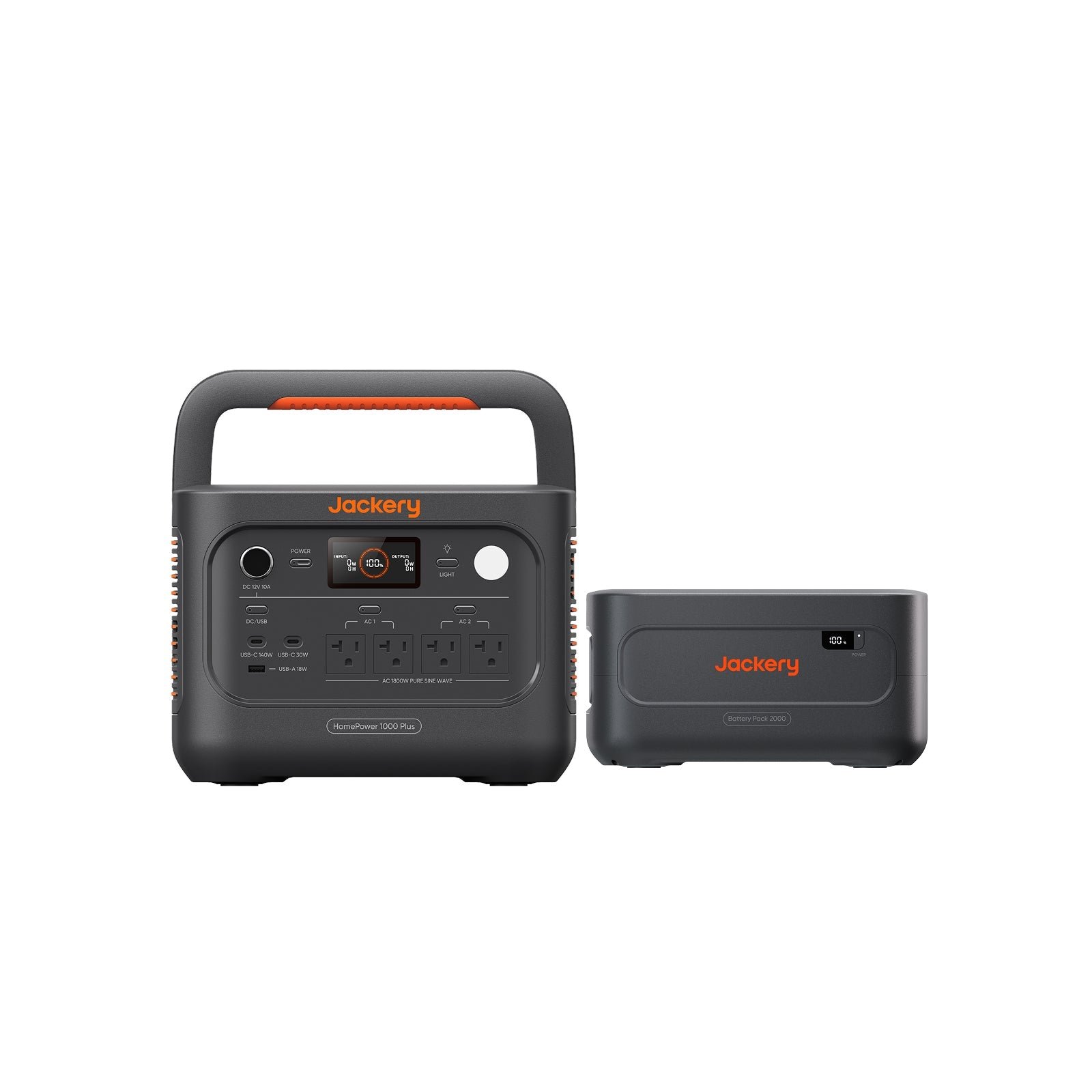
HomePower 1000 Plus v2 — the home-backup pick, and our top choice right now
Best for: homeowners who want one station that handles an outage properly — fridge, Wi-Fi, lights, and a home office — and might add battery capacity later.
This is the newest model here (August 2026) and the most capable. Its 1,800W output is the strongest of the true 1,024 Wh models, so it starts and runs demanding loads like a full-size refrigerator, a microwave in short bursts, or power tools more comfortably than its brothers. The under-10-millisecond UPS switchover means a power cut doesn’t reboot your computer or drop your router — the feature that separates a “home backup” station from a camping battery.
Two more things set it apart. It is expandable: add up to five Battery Pack 2000 Plus v2 units (2 kWh each) and it grows from 1 kWh to as much as 11 kWh over time — buy small now, grow later. And it recharges fast: Jackery rates a full AC charge at about 50 minutes, with up to 400W of solar input (roughly 3.3 hours in strong sun).
The honest catches: it is the priciest of the group, its color choice changes the price (White was $669, Black $749 when we checked), and it only works with the newer Battery Pack 2000 Plus v2 — not the older packs.
See the HomePower 1000 Plus v2 at Jackery →
HomePower 1000 v2 — the budget twin that covers the essentials
Best for: apartment renters and budget buyers who want outage essentials — router, lights, phones, a laptop, and a fridge for a good stretch — without paying for expansion they’ll never use.
Launched in June 2026 at $549–$559 (list $649), this is the value pick of the five. You get the same 1,024 Wh capacity, the same under-10 ms UPS switchover, the same quiet under-30 dB operation, and the same fast 50-minute emergency charge as the Plus v2. Jackery even adds a thoughtful touch called Priority Routing, which shuts down less important devices first when the battery runs low, saving what’s left for the fridge and router.
What you give up versus the Plus v2: output drops to 1,500W (still plenty for essentials), and there is no expansion path — 1,024 Wh is all it will ever hold. If your outages are measured in hours, not days, that trade is worth roughly $200.
See the HomePower 1000 v2 at Jackery →
Explorer 1000 v2 — the best all-rounder, if you can find it in stock
Best for: campers and general users who want one light, fast-charging station for trips and the occasional outage.
Before the HomePower line arrived, this was the default recommendation in the 1 kWh class, and the hardware still earns it: 1,500W output, a 50-minute emergency full charge, dual 100W USB-C ports, 4,000-cycle LiFePO4 battery, a 5-year warranty, and just 23.8 lb — Jackery calls it the world’s smallest and lightest 1 kWh LiFePO4 station. Owners like it too: it holds a 4.72 out of 5 rating across 481 reviews on Jackery’s site.
So why isn’t it our top pick? Availability. On November 6, 2026, Jackery’s own product page carried a “sold out due to high demand” notice and pointed shoppers to the HomePower 1000 Plus v2 instead. When it is in stock, the station alone runs $509 (Dune White) to $559 (Black) — the $879 figure on the page is the bundle with a SolarSaga 200W panel, not the station. If you find it in stock at the station-only price, buy with confidence. If not, the two HomePower models above are the current answer.
Check Explorer 1000 v2 stock at Jackery →
Explorer 1000 Plus — the biggest battery here, with one real catch
Best for: buyers who want the most capacity and fastest solar charging today, and don’t care about expanding later.
On paper this looks like the winner: 1,264 Wh (about 23% more than the others), a strong 2,000W output, up to 800W of solar input — double the rest — and a $619 sale price (list $699). It also carries a strong 4.78 out of 5 rating from 189 reviews.
Here is the catch, stated plainly on Jackery’s own product page: the Battery Pack 1000 Plus has been discontinued. The same page still advertises expanding “up to 5 kWh” with extra packs — but you can no longer buy those packs new. So treat the 1,264 Wh as fixed forever. Bought with open eyes, it’s a lot of station for $619. Bought expecting to expand next year, it’s a dead end — the HomePower 1000 Plus v2 is the expandable one now.
See the Explorer 1000 Plus at Jackery →
The one to skip: Explorer 1000 Pro
The 1000 Pro is a 2022-era model that Jackery has discontinued. On Jackery’s US store it appears only as a refurbished listing — $999, sold out, for a machine with less capacity (1,002 Wh) and far less output (1,000W) than every model above. If you see one “on sale” at a marketplace or reseller, you now know why. There is no price at which it beats the HomePower 1000 v2.
Why Jackery’s own pages disagree — and which numbers we trusted
While preparing this guide we found three contradictions on jackery.com itself, all on November 6, 2026:
- The Explorer 1000 v2 is listed at 1,024 Wh in most places, while its spec table has shown 1,070 Wh.
- The HomePower 1000 Plus v2’s store card claimed 1,280 Wh and 32.6 lb; its own product page says 1,024 Wh and 23.8 lb.
- The $1,269 headline price on that same product page is not the station — it’s the station plus an expansion battery. The station alone is $669–$749. (A neighboring product, the HomePower 3600 Plus, is headlined at $3,999 for a kit whose base station is $1,899 — same pattern.)
None of this makes the products bad. It makes the store pages hard to read. Our rule for this guide: the product page’s own spec section wins, bundle prices are always named as bundles, and every price carries its check date. If you spot a figure here that has changed, that’s the sale season moving — tell us in the comments and we’ll update the Last checked date.
Which one should YOU buy?
- Apartment or short outages, essentials only: HomePower 1000 v2 — same UPS protection, lowest price.
- Fridge + home office, outages that can stretch: HomePower 1000 Plus v2 — strongest output here, and it can grow to 11 kWh later.
- Camping first, backup second: Explorer 1000 v2 — lightest and quickest to recharge, if it’s in stock; otherwise the HomePower 1000 v2 travels nearly as well.
- Most battery for the money today, no expansion plans: Explorer 1000 Plus at $619 — just know the battery is fixed at 1,264 Wh.
- Found a “deal” on a 1000 Pro: skip it. It’s discontinued, and the current models beat it for less.
Our pick for most readers: the HomePower 1000 Plus v2.
Check today’s price on the HomePower 1000 Plus v2 →
Frequently asked questions
How long will a Jackery 1000 run a TV?
A typical modern TV draws about 100W. Using roughly 85% of the battery as usable energy (a normal allowance for inverter losses), a 1,024 Wh model runs it for about 8–9 hours; the 1,264 Wh Explorer 1000 Plus stretches that to roughly 10–11 hours. These are estimates — a big gaming TV at full brightness will use more.
How long will a Jackery run a refrigerator?
A full-size fridge’s compressor cycles on and off, averaging roughly 50–100W over time. On that basis, the 1,024 Wh models keep a typical fridge cold for about 10–14 hours, and the Explorer 1000 Plus a few hours longer. Mini-fridges run far longer; older garage fridges, less. Jackery publishes its own fridge-runtime table if you want model-by-model lab figures.
Can a Jackery 1000 power a whole house?
No. About 1 kWh runs essentials — fridge, Wi-Fi, lights, phones, a laptop — not a whole home with heating, cooking, and laundry. Whole-house backup is what Jackery’s larger HomePower 3000 and 3600 Plus (with an optional transfer switch) are built for. For most apartments and short outages, essentials-only is honestly enough.
What is the difference between the Explorer 1000 v2 and the Explorer 1000 Plus?
The Plus stores more energy (1,264 Wh vs 1,024 Wh), outputs more power (2,000W vs 1,500W), and accepts double the solar input (800W vs 400W). The v2 is lighter, charges just as fast from a wall outlet, and costs less — but its expansion-free design is current, while the Plus model’s expansion battery has been discontinued.
How long does a SolarSaga 200W take to charge the Explorer 1000 v2?
Jackery’s own charging guide puts one 200W panel at about 7.5 hours and two at about 3.8 hours in good sun. Real-world times run longer in winter or with imperfect panel angles — treat those as best-case figures.
Can I use one of these for a CPAP or other medical device?
Jackery states in its own FAQs that its power stations are not recommended for medical or life-support devices, because an unexpected shutdown could be dangerous. Many people do use stations as CPAP backup, but that is a decision to make carefully — ideally discussed with your equipment provider — and never as your only safety net.
The bottom line
The “1000” name hides five genuinely different machines. In November 2026 the honest summary is simple: the HomePower 1000 Plus v2 is the one to buy for home backup, the HomePower 1000 v2 is the same idea for less money, the Explorer 1000 v2 remains the camping-friendly all-rounder when it’s in stock, the Explorer 1000 Plus is a strong fixed-size value at $619, and the 1000 Pro belongs to the past. Whichever you choose, check the station-only price — not the bundle headline — before you pay.
Prices and stock were checked on jackery.com on November 6, 2026 and will move during the Black Friday season. For more options, see our Portable Power hub and our Jackery Explorer 300 guide.